2nd ESA-NASA International Workshop on AI Foundation Models for Earth Observation

ZeroFlood

Flood Hazard Mapping from a single modality input using TerraMind and Thinking-in-Modality.

Hyeongkyun Kim German Aerospace Center (DLR)
Orestis Oikonomou ETH Zurich, ETH AI Center

About

Flood hazard mapping is essential for disaster prevention but...

It remains challenging in data-scarce regions, where traditional hydrodynamic models require extensive geophysical inputs. We introduce ZeroFlood, a framework that leverages the geospatial foundation model (TerraMind) to predict flood hazard maps. It relies only on SAR or multispectral imagery to identify flood-prone regions. This capability is enabled by a Thinking-in-Modality process, which compensates for missing spatial information such as land use/land cover (LULC) and digital elevation models (DEM).

This demo page presents an exploration of ZeroFlood, including:

  • 1. Interactive visualization of selected model predictions
  • 2. Overview of the model architecture and data flow
  • 3. Descriptions of dataset creation and spatial distribution
  • 4. Experimental results comparing performance with baseline models.

Model & Demo

ZeroFlood: Flood hazard mapping with a single-modality

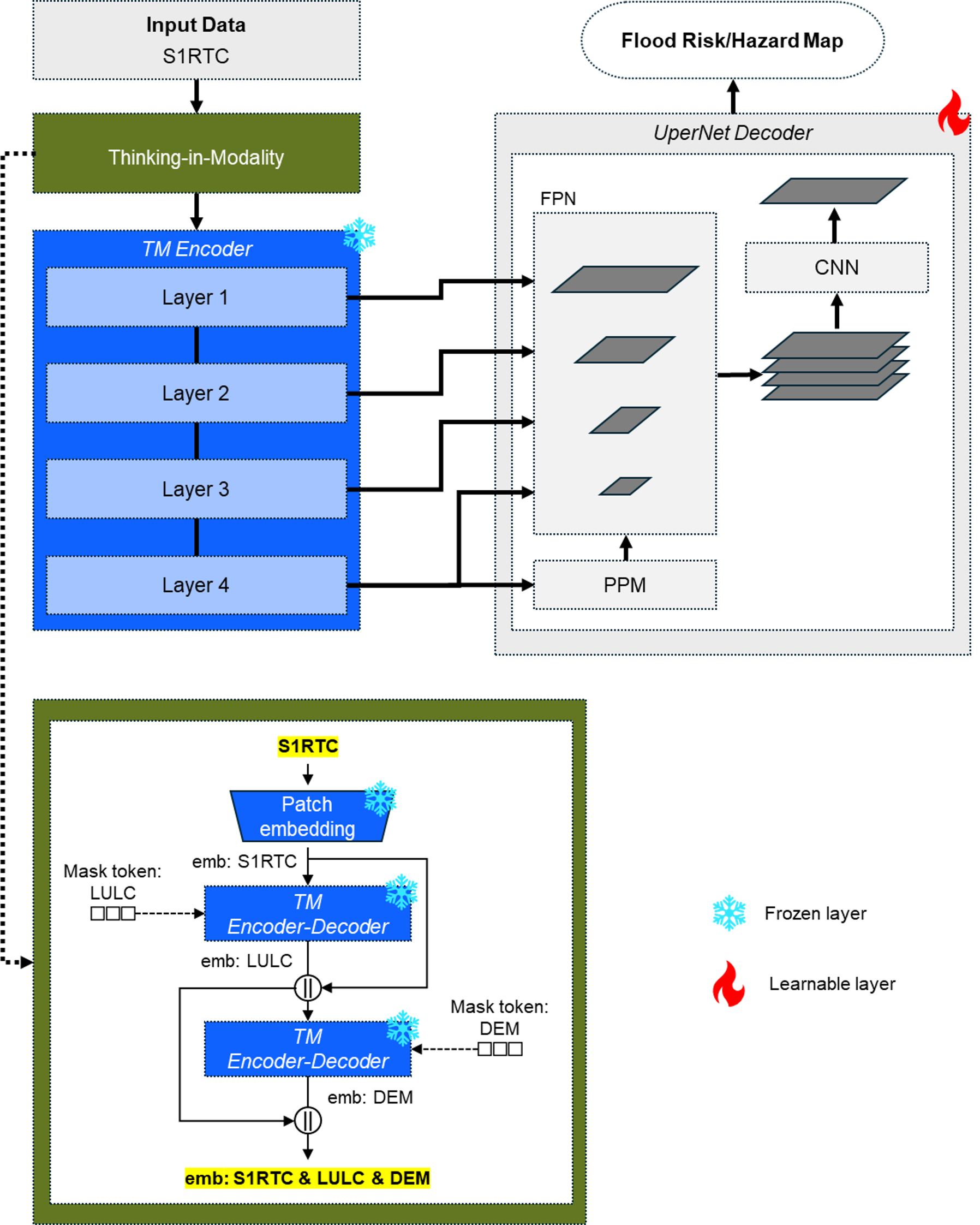
ZeroFlood model architecture
A single- or double-modality input (Sentinel-1, Sentinel-2, or both) is processed through a Thinking-in-Modalities stage that generates auxiliary modalities (e.g., cross-sensor translation, land use/land cover, and digital elevation). These enriched representations are then fed into a TerraMind-based encoder–decoder (with UPerNet) to produce flood hazard area predictions. Therefore, it benefits less data source and computation requirements compared to simulation-based model. This diagram shows an example of S1RTC input with TiM modalities, LULC and DEM.

Dataset

Combining multimodal EO dataset with Flood hazard simulation masks

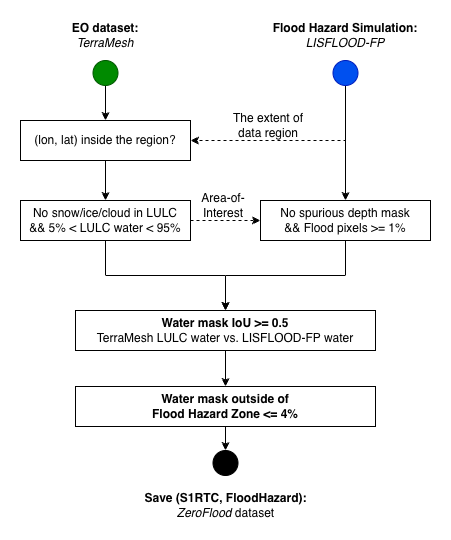
ZeroFlood dataset creation diagram
The ZeroFlood dataset combines two public datasets - an EO dataset (TerraMesh) and flood hazard simulation masks for the European region (LISFLOOD-FP) - following the rule-based quality control and spatial alignment process.
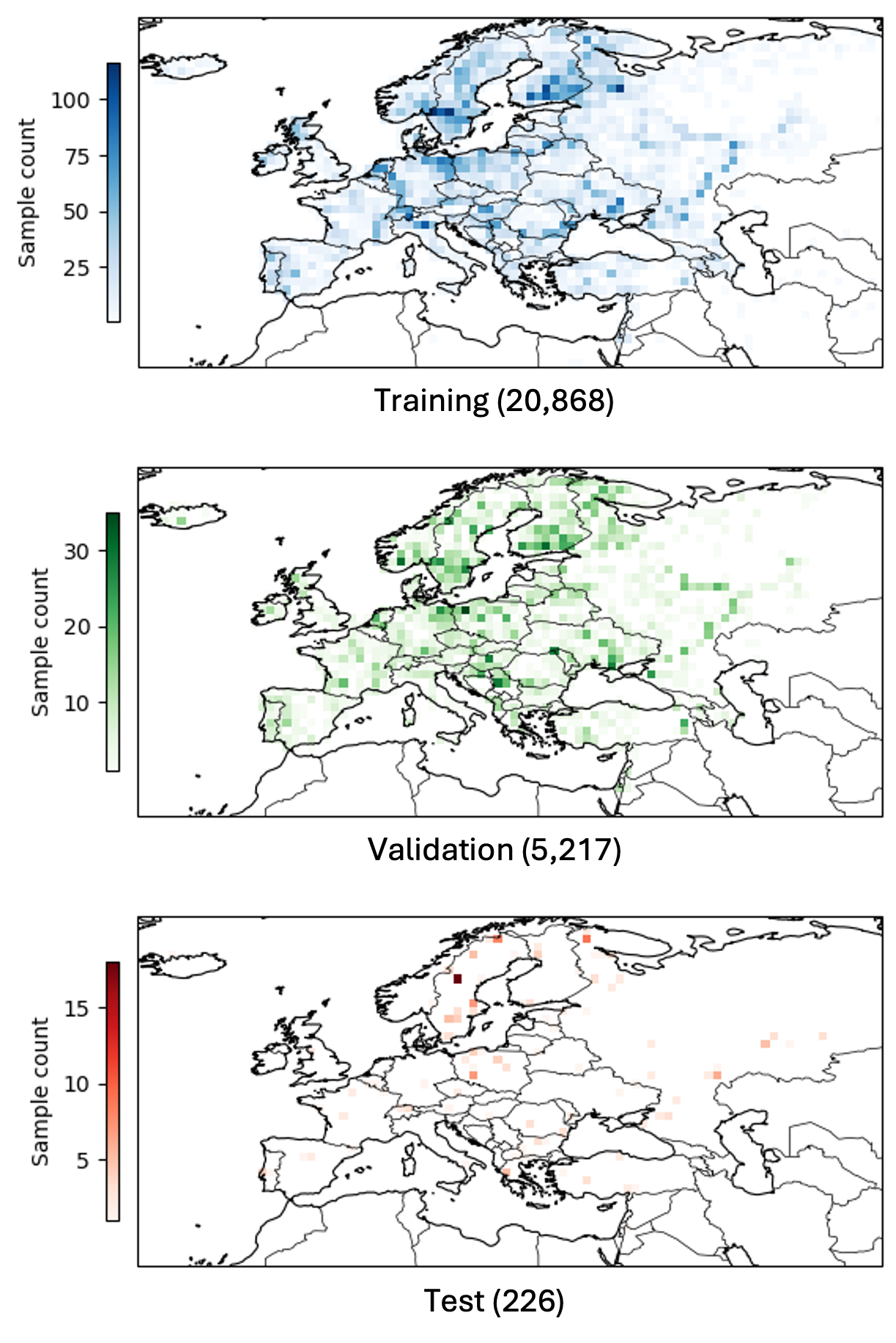
Spatial heat map of ZeroFlood samples
Spatial heatmap of the ZeroFlood dataset at one-degree resolution, with the total number of samples indicated in parentheses.

Experiment results

Evaluate on Baseline, Other GeoFMs, and TerraMind w/ or w/o Thinking-in-Modality

S1RTC input

ModelF1RecallPrecision
UNet84.6681.0088.67
ViT84.6481.4688.08
SSL4EO-MAE85.2381.3989.44
CROMA83.6379.7287.95
DOFA86.9084.8089.11
TerraMind88.3686.7790.02
TerraMind-TiM-l89.1288.4589.80
TerraMind-TiM-ds88.8287.6290.05
TerraMind-TiM-dsl88.5487.5389.57

Evaluation results of the ZeroFlood model using S1RTC as the input modality. Tokens generated by the Thinking-in-Modalities (TiM) process are denoted as: s (S2L2A), l (LULC), and d (DEM). The highest value in each column is highlighted in bold.

Open science

Paper, code, and reproducibility artifacts

@article{kim2025zeroflood,
  title={ZeroFlood: Flood Hazard Mapping from Single-Modality SAR Using Geo-Foundation Models},
  author={Kim, Hyeongkyun and Oikonomou, Orestis},
  journal={arXiv preprint arXiv:2510.23364},
  year={2025}
}
@misc{zerofloodCode2026,
  title={zeroflood},
  author={Kim, Hyeongkyun},
  year={2026},
  publisher={GitHub},
  journal={GitHub repository},
  url={https://github.com/khyeongkyun/zeroflood}
}
@misc{zerofloodDataset2026,
  title={ZeroFlood},
  author={Kim, Hyeongkyun},
  year={2026},
  publisher={Hugging Face},
  journal={Hugging Face dataset},
  url={https://huggingface.co/datasets/khyeongkyun/ZeroFlood}
}